Scope 3 Emissions and the Waste You Can't Ignore: How Pyrolysis Helps Irish Businesses Close the Carbon Gap

The conversations happening in Irish boardrooms about sustainability have shifted. A year ago, the focus was on energy bills and recycling targets. Today, a new term is dominating the agenda: Scope 3 emissions. And for the businesses that haven't yet mapped their full value chain carbon footprint, the regulatory clock is ticking faster than many realise.
The EU's Corporate Sustainability Reporting Directive (CSRD) is now in full force for large companies, and its reach is extending progressively to mid-sized enterprises across Ireland. Among the most challenging categories to account for — and ultimately to reduce — is Category 5: waste generated in operations. This is the carbon burden produced when your business sends material to landfill, incineration, or general waste collections. It is often the invisible carbon that companies overlook precisely because it sits off-site, out of sight, and out of mind.
The problem is that regulators, auditors, and increasingly your own customers are no longer willing to look away.
Why Waste Emissions Have Become a Boardroom Issue
For most of the past decade, corporate sustainability strategies focused on the low-hanging fruit: switching to renewable electricity (Scope 2), upgrading logistics fleets (Scope 1), and signing up to green tariffs. Scope 3 — the indirect emissions upstream and downstream of your operations — was treated as aspirational territory, vaguely referenced in annual reports with little meaningful measurement behind it.
That era is over. The CSRD's European Sustainability Reporting Standards (ESRS) now require businesses to measure, disclose, and set reduction targets across all material Scope 3 categories. For manufacturing, food processing, logistics, pharmaceutical, and agri-business sectors in Ireland, Category 5 waste emissions can represent anywhere from 8% to 25% of a company's total Scope 3 footprint — yet many have no credible plan to address them.
The compliance pressure is compounding. Financial institutions and export customers operating under their own CSRD obligations are beginning to require supply chain partners to provide verified emissions data. In practice, this means that Irish SMEs who supply into large European groups may soon face a stark choice: produce auditable carbon data for your waste streams, or lose the contract.
This is not a future problem. It is happening now.
The Pyrolysis Advantage: From Liability to Ledger Credit
Traditional waste management routes — municipal incineration, landfill, or export for co-processing — generate emissions that are difficult to claim any credit for. Even energy-from-waste incineration, while preferable to landfill, typically produces a carbon footprint that must be declared on your balance sheet.
Pyrolysis offers a fundamentally different accounting position.
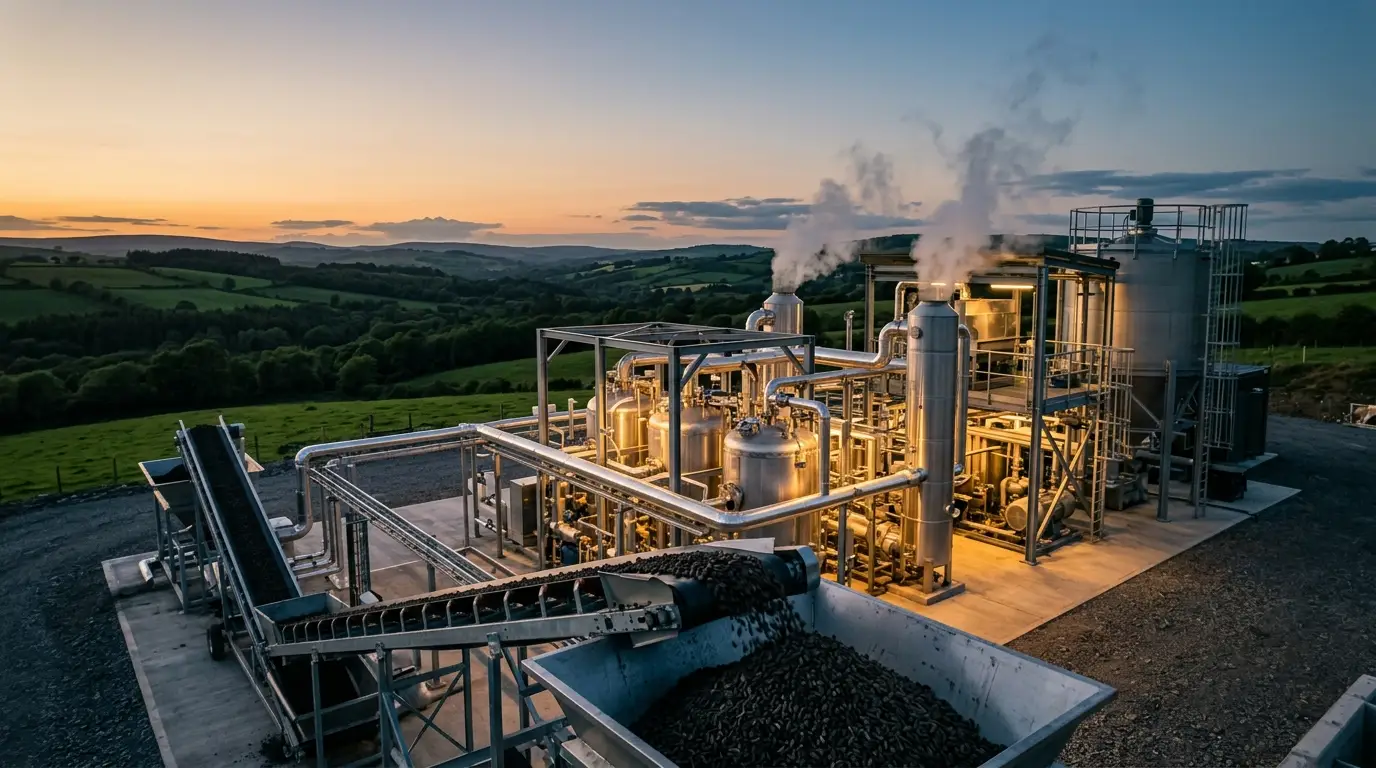
At its simplest, pyrolysis is the thermal decomposition of organic and plastic materials in the absence of oxygen. Rather than burning waste, the process breaks it down into three outputs: pyrolysis oil (a fuel substitute or chemical feedstock), syngas (used to self-power the process), and biochar or carbon char (a solid residue with documented carbon sequestration potential).
When waste that would otherwise enter the combustion or landfill pathway is diverted to a pyrolysis unit, the carbon accounting changes materially:
- Landfill diversion removes the methane and leachate emissions profile associated with organic and mixed waste.
- Avoided incineration emissions reduce the CO₂e declared under Category 5.
- Biochar production from organic inputs can qualify for carbon removal credits under verified methodologies, creating a potential revenue stream alongside the compliance benefit.
- Pyrolysis oil as a fuel substitute offsets fossil-derived fuels elsewhere in the value chain, contributing to Scope 1 reductions for the end user.
Crucially, for CSRD reporting purposes, businesses that deploy on-site or contracted pyrolysis solutions can document the diversion pathway, the output volumes, and the associated emissions avoided — providing auditors with the verifiable, site-level data that general waste contractor invoices simply cannot supply.
Ireland's Regulatory Moment: CSRD Meets Circular Economy Strategy
The timing matters. Ireland's national Circular Economy Strategy and the parallel EU Packaging and Packaging Waste Regulation (PPWR) are driving significant re-engineering of how industrial waste is managed domestically. At the same time, Ireland's landfill levy has been revised upward, and gate fees at licensed disposal facilities continue to rise as capacity constraints bite.
For businesses in sectors with high volumes of residual plastic, rubber, contaminated packaging, or organic process waste, the economics of conventional waste management are deteriorating. The combination of rising disposal costs, tightening recycling thresholds under PPWR, and CSRD reporting obligations is creating a perfect storm — but also a genuine commercial opportunity for those who move early.
Premier Green Energy's pyrolysis solutions are designed specifically for this operational reality. Modular, scalable, and deployable at an industrial facility level, our systems allow organisations to treat residual waste streams on-site — eliminating transport emissions, reducing third-party disposal costs, and generating auditable outputs that feed directly into sustainability reports and carbon reduction programmes.
Measuring What Matters: Building Your Waste Carbon Baseline
Before a business can benefit from pyrolysis in CSRD terms, it needs a credible baseline. This means knowing:
- What materials are in your waste stream — composition, contamination levels, calorific value, and moisture content
- What volumes arise — monthly and annual, by site and by process
- What current disposal route generates in CO₂e — calculated using GHG Protocol Category 5 methodology
- What the alternative treatment pathway would produce — and what verified displacement credits or avoided emissions can be claimed
This is precisely the kind of analysis Premier Green Energy undertakes as part of a waste-to-energy feasibility assessment. The output is not a vague sustainability aspiration — it is a site-specific carbon model that gives finance directors and sustainability managers the numbers they need to report with confidence, and gives operations teams a clear business case with payback projections.
The businesses that will navigate CSRD most effectively are not those with the most ambitious net-zero pledges. They are those that can demonstrate granular, site-level control over every material emissions category — including the waste that currently disappears into a contractor's lorry with no questions asked.
Taking the Next Step
The window for early-mover advantage is narrowing. As more businesses seek to deploy pyrolysis solutions to manage Scope 3 compliance, installation slots, planning bandwidth, and equipment lead times will tighten. Companies that begin feasibility assessments now will be positioned to have operational systems in place before the next reporting cycle intensifies.
If your business generates industrial, manufacturing, or process waste in Ireland and you are not yet in a position to account for the carbon impact of that waste with precision, the conversation with Premier Green Energy starts with a straightforward question: what happens to your residual waste today, and what could it be worth tomorrow?
Contact Premier Green Energy to arrange a waste stream assessment and discover how pyrolysis can transform your Scope 3 liability into a measurable sustainability advantage.


.svg)
.svg)