Pyrolysis Plastics: How Chemical Recycling Is Closing Ireland’s Circular Economy Loop

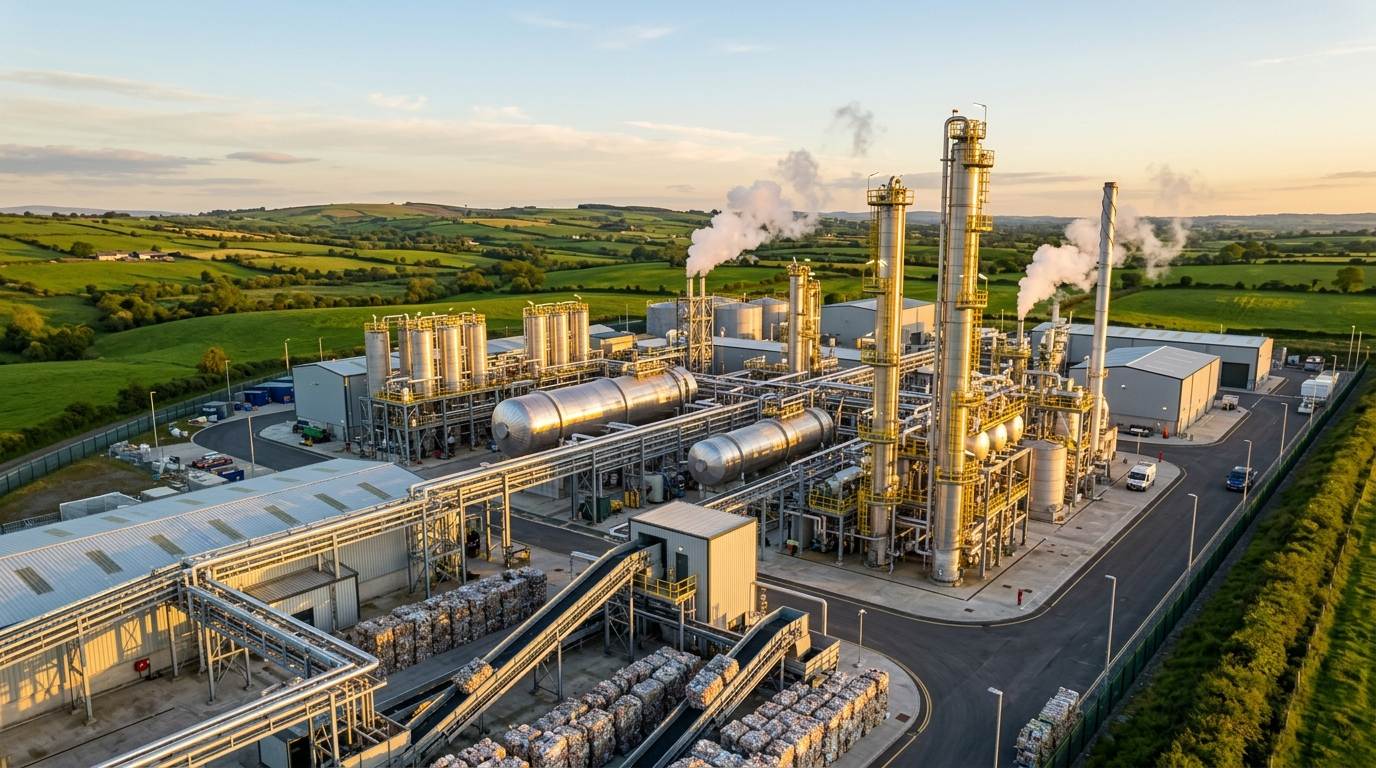
Ireland faces a mounting plastic waste challenge. Despite significant investment in kerbside collection and mechanical recycling infrastructure, a substantial share of the country's post-consumer plastic still ends up in landfill or is shipped overseas for processing — outcomes that are neither economically sustainable nor aligned with Ireland’s 2030 circular economy commitments under the EU Waste Framework Directive.
The answer, increasingly, lies not in better sorting or cleaner collection but in a fundamentally different approach to end-of-life plastics: chemical recycling through pyrolysis.
What Is Pyrolysis — and Why Does It Matter for Plastic Waste?
Pyrolysis is a thermochemical process that decomposes organic materials — including mixed and contaminated plastics — at elevated temperatures in the absence of oxygen. Unlike mechanical recycling, which physically reprocesses plastic into lower-grade material and is limited to relatively clean, single-stream feedstocks, pyrolysis breaks plastic down to its molecular constituents, producing a synthetic crude oil (pyrolysis oil or “pyoil”), combustible gas, and a solid char residue.
The significance of this is hard to overstate. Plastics that would otherwise be unrecyclable by conventional means — multilayer packaging, contaminated food-contact plastics, mixed polymer streams — can be processed through pyrolysis and converted into feedstocks that re-enter the petrochemical supply chain. The pyoil can be used to manufacture virgin-equivalent plastic, closing the loop in a way mechanical recycling fundamentally cannot.
For Irish businesses generating mixed plastic waste at scale — manufacturers, food processors, logistics operators — this represents a paradigm shift in how residual plastic streams can be managed and valorised.
The Regulatory Landscape Is Moving in Pyrolysis’s Favour
For several years, chemical recycling occupied an uncertain regulatory position within the EU’s circular economy framework. The core question was whether pyrolysis-derived feedstocks could qualify as “recycled content” under the EU Packaging and Packaging Waste Regulation (PPWR) and whether pyoil-based plastics could count toward the recycled content mandates being phased in from 2030 onward.
That uncertainty is now resolving. The European Commission’s methodology for calculating recycled content from chemical recycling — using mass balance accounting — has gained regulatory traction across member states, and Ireland’s Environmental Protection Agency has published guidance acknowledging chemical recycling as a legitimate complementary pathway alongside mechanical recycling.
The practical implication for corporate sustainability teams is significant: chemical recycling via pyrolysis now represents a credible, auditable route to meeting Extended Producer Responsibility (EPR) obligations and demonstrating recycled content compliance — not just an emerging technology to monitor from a distance.
Three Reasons Irish B2B Operators Are Investing in Pyrolysis Now
1. Access to Otherwise Unrecyclable Feedstocks
Many Irish industrial and commercial operations generate plastic waste that is technically recyclable but practically unrecyclable at commercial scale — contaminated stretch wrap, composite packaging, multilayer films. These streams have historically incurred disposal costs with no recovery value. Pyrolysis plants can accept these mixed, lower-quality feedstocks and convert them into tradeable commodity outputs.
Premier Green Energy’s modular pyrolysis systems are engineered precisely for this reality: scalable configurations that suit mid-to-large waste generators who need on-site or near-site processing capacity, without the capital commitment of large centralised facilities.
2. Revenue Generation from Waste Streams
Pyrolysis doesn’t just solve a disposal problem — it creates an economic opportunity. Pyoil commands a market price that, depending on crude oil benchmarks and offtake agreements, can meaningfully offset the total cost of waste management. Char residues from certain plastic streams also have applications as carbon black substitutes or soil amendment products, adding further revenue potential.
For businesses operating under tightening margins, the shift from paying gate fees to generating commodity revenue from the same waste stream represents a material improvement to the bottom line.
3. Demonstrable Carbon and ESG Credentials
Ireland’s corporate sustainability reporting landscape has changed substantially. Under the EU Corporate Sustainability Reporting Directive (CSRD), a growing number of Irish companies are now required to report on Scope 3 waste emissions and demonstrate credible decarbonisation pathways. Diverting plastic waste from landfill or incineration into a circular chemical recycling loop provides quantifiable, third-party-verifiable carbon benefits that contribute directly to CSRD-aligned sustainability disclosures.
Pyrolysis, in this context, is not merely a waste management solution — it is an ESG asset.
The Road Ahead: Scale, Collaboration, and Offtake Infrastructure
The commercialisation of chemical recycling in Ireland is not without challenges. Feedstock logistics, planning consent for thermal processing facilities, and the development of robust offtake markets for pyoil and char are all areas requiring continued investment and policy support.
What is clear is that the technology is mature, the regulatory environment is aligning, and the economics are compelling. The companies that move earliest to integrate pyrolysis into their waste management and sustainability strategies will not only reduce costs and liabilities but will be positioned to benefit disproportionately as EPR obligations and recycled content mandates tighten through the late 2020s.
Premier Green Energy works with Irish and UK businesses at every stage of this journey — from initial feasibility assessment through to full-scale pyrolysis plant deployment. If your organisation is generating mixed or contaminated plastic waste and looking for a credible, commercially-attractive circular economy pathway, we’d welcome a conversation.
Contact Premier Green Energy today to discuss how pyrolysis can transform your plastic waste challenge into a circular economy asset.


.svg)
.svg)