From Waste to Watts: How Ireland's Industrial Sector Is Unlocking Energy Independence Through Pyrolysis

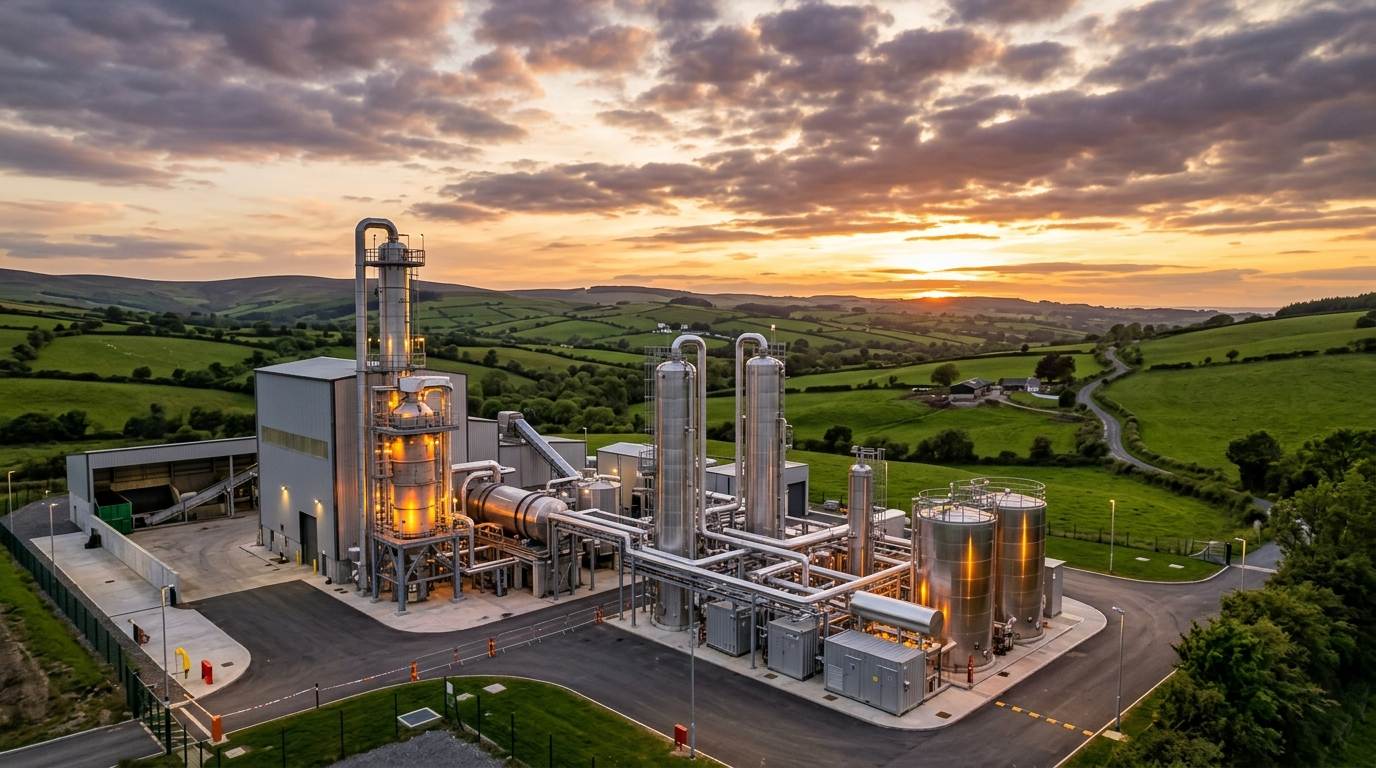
Ireland’s industrial sector faces a twin pressure that shows no sign of easing: spiralling energy costs and tightening legislative obligations around plastic and mixed-waste disposal. For manufacturers, food processors, agri-businesses, and logistics operators across the island, the traditional answer — landfill or export — is becoming untenable both financially and legally.
Pyrolysis is changing that calculation. Once considered a niche technology, it has matured into a commercially proven, scalable solution that converts residual plastic and organic waste streams into synthetic fuel oils, combustible gas, and carbon char — all within a closed, controlled process that generates minimal emissions. In 2026, it is no longer a question of whether pyrolysis works. It is a question of whether your business is capturing its value yet.
The Pressure Is On: Ireland’s Energy and Waste Landscape in 2026
Ireland imports approximately 85% of its energy needs, a structural vulnerability that has translated into persistently high electricity and fuel prices for industry. At the same time, the EU’s revised Packaging and Packaging Waste Regulation (PPWR), which entered application phases in 2025, is tightening recycled content requirements and placing new obligations on producers and processors of plastic packaging. Extended Producer Responsibility (EPR) levies are rising, and the cost of exporting contaminated or mixed plastic waste to third-party processors has increased substantially following global commodity shifts.
Irish businesses are also under pressure from Scope 1 and Scope 2 emissions reporting obligations. Large companies subject to the Corporate Sustainability Reporting Directive (CSRD) — which came into force for many Irish entities in 2025 and 2026 — must now account transparently for their waste disposal methods and on-site energy use. Landfilling or incinerating plastic waste without energy recovery increasingly looks like a liability on both counts.
Against this backdrop, the appeal of a technology that simultaneously reduces waste disposal costs, generates usable energy on-site, and contributes to Scope 1 emissions reduction becomes very clear indeed.
How Pyrolysis Converts Industrial Plastic Waste Into Usable Energy
Pyrolysis is a thermochemical process that decomposes organic and polymeric materials — principally plastics, rubber, and biomass — at elevated temperatures (typically 300–700°C) in the absence of oxygen. Unlike combustion, there is no burning; instead, the feedstock undergoes thermal decomposition into three recoverable products:
- Pyrolysis oil (pyro-oil): A synthetic hydrocarbon fuel analogous to diesel or heavy fuel oil, suitable for direct combustion in industrial burners, generators, or kilns — or as a feedstock for further refining.
- Syngas (synthesis gas): A combustible gas mixture of hydrogen, carbon monoxide, and light hydrocarbons, which can be combusted on-site to provide process heat or fed into a gas engine for electricity generation.
- Carbon char: A solid residue with applications as a soil amendment (biochar), a fuel supplement, or an industrial carbon source.
A well-configured pyrolysis system can process a wide range of plastic waste types — including polyethylene (PE), polypropylene (PP), polystyrene (PS), and mixed plastics that are unsuitable for mechanical recycling — converting them into these energy carriers at a thermal efficiency of 70–85%.
For an Irish manufacturer generating, say, five tonnes of plastic film waste per week, a compact pyrolysis unit can convert that stream into approximately 3,500–4,000 litres of pyro-oil weekly. At current industrial fuel prices, that equates to a significant direct cost offset — without the gate fees, transport charges, and compliance costs associated with sending that material off-site.
The Business Case: ROI, Compliance, and Competitive Advantage
The financial case for on-site pyrolysis has strengthened considerably over the past three years. Capital costs for modular, containerised pyrolysis units have fallen as the technology has standardised and supply chains for components have matured. Operating costs — principally electrical power for the process and modest labour — are modest relative to the value of the fuel output. For most mid-sized industrial operators, the capital payback period for a correctly-sized system sits in the range of two to four years, depending on waste volume, feedstock quality, and local fuel prices.
Beyond the direct energy economics, businesses are reporting a range of secondary benefits:
- Waste disposal cost elimination: Gate fees for mixed plastic waste in Ireland can range from €120 to €300 per tonne. Eliminating or substantially reducing those costs materially improves margins for waste-intensive operations.
- Energy price certainty: On-site fuel generation provides a degree of insulation from grid electricity price volatility — a material consideration for energy-intensive manufacturers.
- Carbon accounting: Pyrolysis of end-of-life plastics that would otherwise be landfilled or incinerated without energy recovery can support a business’s Scope 1 and Scope 2 emissions reduction narrative under CSRD and voluntary ESG frameworks.
- Supply chain positioning: Increasingly, large buyers — particularly in retail, food and beverage, and pharmaceuticals — are asking suppliers to demonstrate circular economy credentials. On-site waste-to-energy capabilities are a concrete, verifiable signal.
It is important to be clear-eyed about what pyrolysis is not. It is not a replacement for upstream waste reduction or high-quality mechanical recycling of clean, sorted plastics — those routes remain preferable where they are technically and economically viable. Pyrolysis is the solution for the residual fraction: the contaminated, mixed, or technically unrecyclable material that currently has no viable circularity pathway.
Ireland’s plastic waste management infrastructure has historically been export-dependent for this fraction. Pyrolysis offers the opportunity to close that loop domestically, retaining the energy value of the material within the Irish economy.
Making It Work: Implementation Considerations
Feedstock characterisation is the starting point. Not all plastics pyrolyse equally — PVC and PET, for instance, require pre-treatment or should be excluded from the feedstock mix. A thorough waste stream audit, conducted before system selection, ensures the chosen technology is correctly matched to the material available.
Planning and permitting is a consideration that catches some operators off-guard. Pyrolysis units operating above certain throughput thresholds require an Industrial Emissions Licence (IEL) or a Waste Licence from the EPA, depending on scale and feedstock type. Engaging experienced advisers early in the process avoids costly delays.
Technology selection and sizing matters enormously. The pyrolysis equipment market spans a wide range of maturity levels — from proven, commercially-warranted systems with extensive reference installations to early-stage units still working through technical validation. Buyers should prioritise technology providers with demonstrable track records and independent performance data.
At Premier Green Energy, we work with Irish businesses across the agricultural, manufacturing, and waste management sectors to identify, design, and implement pyrolysis and waste-to-energy solutions that are matched to their specific operational context. Our approach begins with a no-obligation feasibility assessment — covering waste stream characterisation, system sizing, energy output modelling, and an indicative financial case.
If your business is generating plastic waste that you currently send off-site for disposal, the chances are high that a pyrolysis solution can turn that cost centre into an energy asset. The technology is proven, the economics are increasingly compelling, and the regulatory environment is moving in one direction only.
Contact the Premier Green Energy team today to arrange a feasibility consultation and find out what your waste stream could be worth. Visit pge.ie or call our team to get started.


.svg)
.svg)