Ireland's 12% Target: What the Circular Economy Strategy 2026-2028 Means for Advanced Recycling

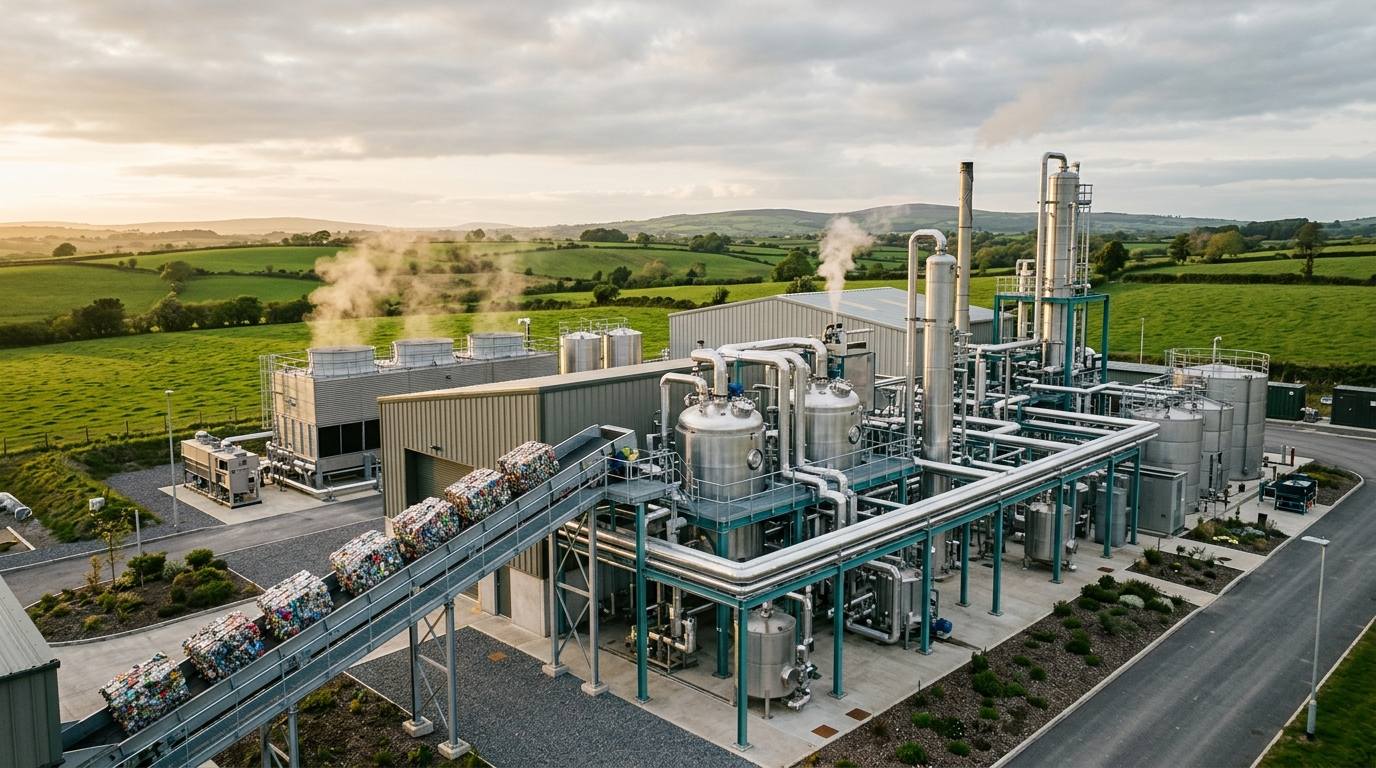
In February 2026 the Government published the Whole-of-Government Circular Economy Strategy 2026-2028, subtitled Accelerating Action. Its headline commitment is precise and measurable: raise Ireland's Circular Material Use Rate (CMUR) by two percentage points every year, reaching 12% by 2030. For a country whose CMUR has sat among the lowest in the European Union — in low single digits, well behind an EU average that hovers around 11-12% — that is a steep climb over a short runway. It also changes the commercial context for every organisation that generates, handles or processes waste in Ireland.
This is not another aspirational framework. It is a three-year action plan with annual milestones, cross-departmental ownership and a dedicated commitment to the monitoring and compliance infrastructure needed to track progress. For waste-to-energy operators, reprocessors and the manufacturers who supply them with feedstock, the strategy sharpens a question that has been building for two years: what is the highest-value destination for a tonne of hard-to-recycle material?
Why the Circular Material Use Rate matters now
The Circular Material Use Rate measures the share of total material demand met by recycled waste rather than by newly extracted virgin resources. Because it is a harmonised Eurostat indicator, national performance is measured on a consistent basis and compared openly across member states. Ireland's low position reflects structural factors: a construction sector that has historically leaned on primary aggregates, limited domestic reprocessing capacity, significant export of collected recyclate, and a waste hierarchy that in practice has prioritised diversion from landfill through energy recovery and export rather than genuine material circulation.
Doubling the rate within a few years cannot be delivered by refining kerbside collection alone. The materials that hold back Ireland's CMUR are precisely those that conventional mechanical recycling struggles with: mixed and contaminated plastics, multilayer packaging, end-of-life tyres, and certain textiles and composites. Moving these streams from disposal into circulation requires new domestic capacity capable of processing them into materials that manufacturers will actually buy. That is where advanced recycling routes, including pyrolysis, become part of the national calculation rather than a niche technology.
The policy stack is now aligned
What makes the 2026-2028 period distinctive is that several instruments are pulling in the same direction at the same time:
- Circular Economy Strategy 2026-2028 — the 12% CMUR target with annual milestones, support for local-authority reuse and repair hubs, a National Bioeconomy Strategy, a food-waste roadmap targeting a 50% reduction by 2030, and investment in the data systems that underpin compliance.
- EU Packaging and Packaging Waste Regulation (Regulation (EU) 2025/40) — in application since 12 August 2026, introducing mandatory recycled-content thresholds for plastic packaging that rise toward 35% for some categories by 2030, alongside recyclability design rules and a 90% separate-collection target for plastic bottles by 2029.
- The All-Island Circular Economy Forum, led by InterTradeIreland, exploring regulatory alignment, shared green public procurement and cross-border resource-matching services.
- ETS2, the EU's second emissions trading system, which from 2027 will put a carbon price on fuels used in commercial buildings, road transport and smaller industry — raising the cost of the residual-waste and fossil-feedstock status quo.
The combined effect is that demand-side pull and supply-side push are arriving together. Recycled-content mandates create a guaranteed market for circular feedstock, while landfill constraints, levies and carbon pricing steadily erode the economics of disposal. Material that used to be a cost line on a waste contract is becoming a contractually valuable input.
Where advanced recycling fits
Pyrolysis and related thermochemical processes break down polymer chains in mixed or contaminated plastic waste at high temperature in the absence of oxygen. The primary output is pyrolysis oil, a hydrocarbon feedstock that can be refined into naphtha and monomers and used to make virgin-equivalent polymers. Crucially, this keeps the carbon locked in materials rather than releasing it through combustion, which is the distinction between diverting waste from landfill and genuinely returning it to circulation.
The mechanism that connects an Irish waste stream to a brand owner's 2030 recycled-content obligation is mass-balance accounting. Under a mass-balance model, recycled input entering a production system is allocated to finished products and verified through independent chain-of-custody schemes such as ISCC PLUS or REDcert2. This is what allows a converter to make a defensible recycled-content claim on packaging that is chemically identical to its fossil-based equivalent.
Two caveats matter for anyone building a business case. First, the detailed mass-balance rules under the PPWR are still being finalised, with the European Commission consulting on allocation methods, the treatment of imports and sustainability criteria; the direction of travel is clear but the precise accounting is not yet fixed. Second, the carbon and circularity credentials of any pyrolysis operation depend heavily on its energy and hydrogen inputs and on end-of-waste and by-product status determinations. Advanced recycling is a complement to mechanical recycling for the fraction it cannot handle — not a replacement for it.
What this means for Irish businesses
For waste producers — manufacturers, retailers, logistics operators and the agri-food sector — segregation quality is becoming a revenue lever rather than a compliance checkbox. Clean, well-characterised polymer fractions command offtake interest; mixed residual waste does not. Expect procurement teams and sustainability reporting to start asking for chain-of-custody evidence, both for Scope 3 disclosure and for packaging-compliance documentation.
For the waste and resource-recovery sector, the margin is shifting from gate fee plus energy sales toward the supply of defined feedstock for reprocessing. Policy certainty through 2028, combined with the PPWR demand signal, materially strengthens the investment case for domestic capacity. Traceability and data systems — which the national strategy explicitly funds — are now table stakes for participating in that market.
For local authorities, the reuse and repair hub programme and the resource-matching ambition of the All-Island Forum create an opening to connect local material flows with regional processing infrastructure rather than defaulting to export.
The window is 2026 to 2028
Because the strategy sets annual CMUR milestones, the procurement, planning and permitting decisions taken over the next 18 months will largely determine whether the 2030 target is within reach. Operators who secure feedstock agreements, certification and offtake arrangements now will be positioned as the compliance route that manufacturers and packaging converters need — rather than competing for the same contracts once the deadlines are closer and the capacity gap is obvious to everyone.
Talk to Premier Green Energy
Premier Green Energy works with Irish manufacturers, waste operators and local authorities to turn hard-to-recycle waste streams into certified circular feedstock. If you are assessing how the Circular Economy Strategy 2026-2028 and the PPWR affect your material flows, contact our team at pge.ie for a feedstock and offtake assessment.


.svg)
.svg)