Ireland's Industrial Operators and the Rising Cost of Residual Waste: Why On-Site Pyrolysis Is Becoming the Rational Choice

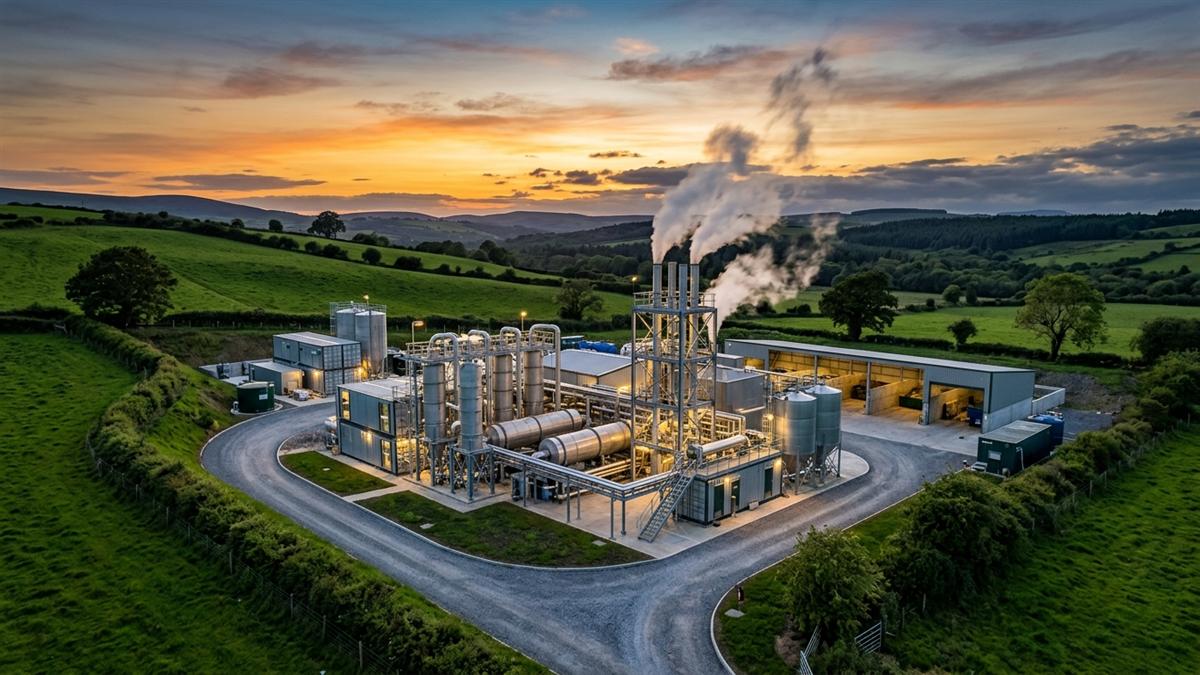
For many Irish industrial operators, the cost of residual waste disposal has become one of the more difficult line items to manage. Gate fees at landfill sites continue to rise. Export routes for refuse-derived fuel (RDF) are narrowing as European receiving markets impose tighter restrictions. The carbon cost of waste haulage is attracting increasing regulatory scrutiny. And ESG reporting requirements are putting a premium on being able to demonstrate measurable progress on waste diversion and emissions reduction.
Against this backdrop, on-site pyrolysis is shifting from a niche consideration to a mainstream commercial option. For facilities generating significant volumes of residual, non-recyclable waste — manufacturing plants, food producers, logistics hubs, construction material processors — the economics and the compliance case are increasingly aligned.
This piece sets out why, and what Irish industrial operators should be thinking about as they plan their waste management strategies for the next five years.
The Waste Cost Squeeze Is Getting Tighter
The trend line on residual waste disposal costs in Ireland has been consistently upward. Landfill levy increases, the introduction of new compliance regimes, and the progressive closure of low-cost export routes have all contributed to a structural shift in the economics of residual waste management.
Ireland's national landfill levy has been used deliberately as a policy instrument to drive waste up the hierarchy — and it has worked, to a point. But for residual waste streams that genuinely cannot be recycled under current infrastructure, organisations are increasingly trapped: they cannot recycle it, they do not have cheap export options, and landfill is becoming prohibitively expensive.
The levy is not the only pressure. Many Irish industrial operators are subject to waste management conditions as part of their operating licences or planning permissions, with landfill diversion requirements that are becoming more demanding over time. Failure to demonstrate progress on these targets creates regulatory exposure that adds a further dimension to the cost equation.
What Changes When You Process Waste On-Site
Introducing on-site pyrolysis fundamentally restructures the economics of residual waste for an industrial operator.
Rather than paying to have waste collected, transported, and disposed of at a third-party facility, the operator converts that waste into three outputs: electricity (which can be used on-site or exported to the grid), synthetic gas (which can be used as process heat), and carbon char (a stable by-product with applications in soil amendment and industrial processes).
The costs that were previously paid to external waste contractors — gate fees, haulage, levy charges — are replaced by the capital cost of the pyrolysis unit, its operating costs, and the revenue or avoided cost from the energy outputs. For operators generating sufficient volumes of compatible waste, the shift in economics can be material.
Premier Green Energy's PRIMA 3000 system processes approximately three tonnes of RDF per operating unit and generates up to three megawatts of electrical output. For a manufacturing facility currently spending significant sums per tonne on residual waste disposal, the payback calculation changes substantially when that waste stream becomes an input to an energy-generating asset.
From Cost Centre to Energy Asset: The Financial Case
The financial case for on-site pyrolysis has strengthened considerably over the past two years, driven by three converging factors.
First, energy prices in Ireland remain elevated compared to historical norms. The value of on-site electricity generation — whether consumed directly or exported under a grid contract — is higher than it was five years ago, improving the financial return on the energy output side of the equation.
Second, disposal costs have risen faster than most operators anticipated in their long-term waste management planning. The gap between what organisations modelled as their future disposal costs and what they are actually paying has created unexpected budget pressure, which is prompting a more active search for alternatives.
Third, the modular nature of the PRIMA 3000 system reduces the capital commitment required to access pyrolysis technology. Operators do not need to commit to a large centralised facility. A single PRIMA 3000 unit can be deployed at scale, with additional capacity added as the waste stream and financial case justify it.
The result is a financial model that is accessible to a wider range of Irish industrial operators than would have been the case under earlier generations of waste-to-energy technology — which typically required very large waste volumes and very large capital budgets to justify.
Meeting ESG and Compliance Obligations
Beyond the direct financial case, on-site pyrolysis creates value in two compliance dimensions that are increasingly material to Irish industrial operators.
The first is greenhouse gas reporting. Converting residual waste into energy on-site, rather than sending it to landfill or exporting it for energy recovery elsewhere, has a measurable impact on a facility's Scope 1 and Scope 3 emissions profile. Landfill generates methane — a potent greenhouse gas — from organic content in residual waste. Export adds transport emissions. On-site pyrolysis replaces both with a process that converts waste to energy more efficiently and generates outputs that offset the use of grid electricity or other fuels.
For operators subject to emissions reporting requirements — whether under EU Taxonomy frameworks, supply chain due diligence requirements, or corporate sustainability disclosures — the ability to document this shift is increasingly valuable.
The second compliance dimension is waste regulation. Ireland's EPA and local authorities are progressively tightening the conditions under which operators can manage their residual waste streams. On-site pyrolysis provides a documented, auditable treatment route that reduces reliance on disposal options that face increasing regulatory pressure.
For facilities that are currently reliant on landfill or RDF export as their primary residual waste treatment route, investing in on-site pyrolysis now positions them ahead of the regulatory curve rather than behind it.
Taking the First Step
For Irish industrial operators who have not previously considered pyrolysis, the natural starting point is a waste stream assessment. Premier Green Energy works with prospective partners to understand the composition, volume, and consistency of their residual waste, assess the suitability of that waste for the PRIMA 3000 system, and model the financial and operational outcomes of deployment.
The process is straightforward, and the information required is typically available from existing waste management records. It does not require a capital commitment to explore whether the technology is a fit.
With operational plants running in Thurles, Co. Tipperary and Hirwaun, Wales, Premier Green Energy has a live reference base for Irish operators to draw on — not projected models, but real-world performance data from facilities processing waste and generating energy under commercial conditions.
The rising cost of residual waste disposal is not a trend that is likely to reverse. The question for Irish industrial operators is not whether to address it, but how — and on-site pyrolysis is increasingly the answer that makes economic and regulatory sense.
Contact Premier Green Energy to discuss whether the PRIMA 3000 is the right fit for your facility's residual waste stream. Arrange a no-obligation feasibility conversation with our team at pge.ie.


.svg)
.svg)