Chemical Recycling at Scale: How Pyrolysis Is Closing the Loop on Plastic Waste in 2026

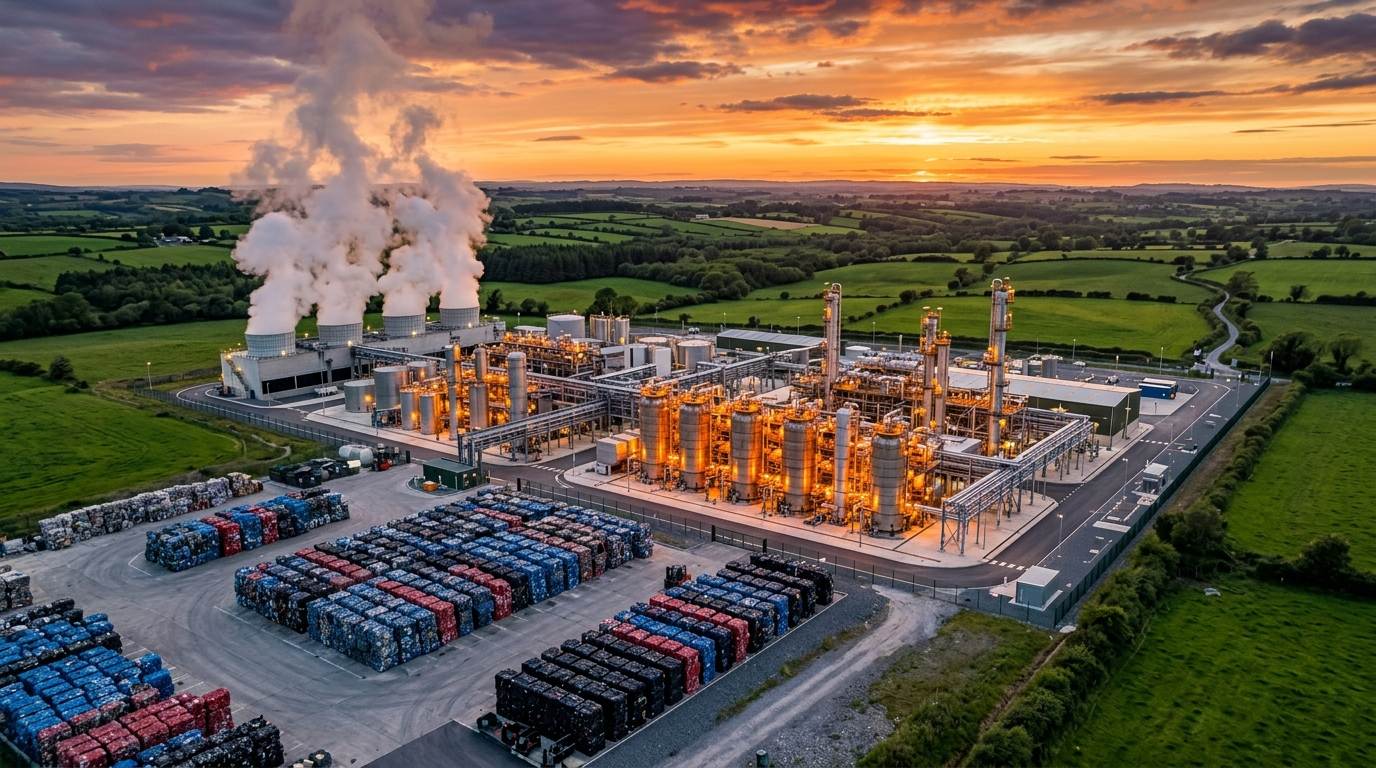
The European Union's circular economy agenda has reached a critical inflection point. With the Packaging and Packaging Waste Regulation (PPWR) fully in force and recycled content mandates tightening across industries, businesses throughout Ireland and Europe are confronting an uncomfortable truth: mechanical recycling alone cannot close the plastic loop.
That gap is precisely where pyrolysis steps in — and in 2026, the technology is no longer a laboratory curiosity. It is a commercially proven, rapidly scaling solution that is fundamentally reshaping how industry views plastic waste.
What Pyrolysis Actually Does — and Why It Matters Now
Pyrolysis is a thermochemical process that breaks down polymer chains in mixed or contaminated plastic waste at high temperatures in the absence of oxygen. The output is pyrolysis oil (also called pyrolysis liquid or PLO), a hydrocarbon feedstock that can be refined into diesel, naphtha, or — critically — virgin-equivalent plastic monomers for use in new packaging and industrial products.
Unlike mechanical recycling, which degrades polymer quality with each cycle and cannot process contaminated, multi-layer, or mixed-resin plastics, pyrolysis handles the most challenging waste streams. Films, flexible packaging, polystyrene foam, agricultural plastics, end-of-life tyres — all materials that currently flow to landfill or incineration — are viable feedstocks for a well-designed pyrolysis system.
This capability is increasingly important. Under the PPWR, manufacturers placing packaging on the EU market face mandatory recycled content requirements of up to 35% for certain plastic categories by 2030. With mechanical recycling capacity nowhere near sufficient to meet projected demand for certified recycled content, chemical recycling is emerging as not just a complementary technology but an essential one.
Industry analysis from mid-2026 places European chemical recycling capacity at roughly 600,000 tonnes per year — up from under 200,000 tonnes in 2023. Ireland, with its growing food and pharmaceutical manufacturing base and some of Europe's highest plastic waste generation per capita, is well positioned to benefit from domestic pyrolysis infrastructure.
The Circular Economy Case: Beyond Compliance
It would be a mistake to frame pyrolysis purely as a compliance instrument. The business case extends well beyond avoiding regulatory penalties.
Feedstock security and cost resilience. Petrochemical feedstock prices have been volatile throughout the early 2020s, driven by energy market disruption and geopolitical instability. Recycled pyrolysis oil, produced domestically from waste streams that businesses already generate or manage, offers an alternative sourcing route that is partially insulated from global commodity markets. Companies with long-term offtake agreements with pyrolysis operators are already reporting greater predictability in their raw material costs.
Brand differentiation and B2B sustainability credentials. Enterprise procurement teams across retail, FMCG, and manufacturing are embedding supplier sustainability requirements into their tender processes. The ability to demonstrate use of chemically recycled content — verified through mass balance accounting under ISCC PLUS or REDcert² certification schemes — is becoming a meaningful differentiator in competitive B2B markets. Packaging buyers are paying a premium for certified recycled-content resin, and that premium has held firm despite broader inflationary pressures.
Waste management cost reduction. Businesses generating significant volumes of mixed plastic waste — logistics operations, food processors, agricultural enterprises — currently pay substantial gate fees for disposal. Integration with a pyrolysis supply chain, either through direct tipping agreements or via a third-party waste management partner, can transform a cost centre into a feedstock supply relationship. Depending on contract structure and local tipping fee levels, some high-volume waste generators are effectively achieving net-zero disposal costs.
Carbon accounting benefits. With scope 3 emissions reporting now mandatory for large companies under the EU Corporate Sustainability Reporting Directive (CSRD), the carbon intensity of waste disposal has moved onto finance directors' radar. Pyrolysis typically generates significantly lower lifecycle greenhouse gas emissions per tonne of plastic processed compared to landfill or incineration, and the recycled content it produces displaces virgin petroleum feedstock. These avoided emissions are increasingly material in corporate carbon accounts.
What Distinguishes Leading Pyrolysis Operations
Not all pyrolysis systems are equal. As the sector matures, a clear performance hierarchy is emerging between operations that deliver consistent, bankable output and those that struggle with yield variability, contamination issues, or regulatory compliance.
The key differentiators are feedstock preparation, reactor design, and downstream processing.
Feedstock preparation is frequently underestimated. Effective sorting and pre-processing — removing PVC, halogenated materials, and moisture — is critical to protecting reactor integrity and ensuring output oil quality meets downstream refinery specifications. Operations that invest in automated sorting, drying, and densification infrastructure consistently outperform those that accept unsorted mixed waste without pre-treatment.
Reactor design determines thermal efficiency, throughput consistency, and the degree of process control available to operators. Continuous-feed reactor configurations, which maintain steady-state conditions and allow real-time monitoring of temperature profiles and residence times, generally deliver higher and more consistent oil yields than batch systems. They also facilitate better process data collection for environmental permitting and certification audits.
Downstream processing — specifically the degree to which raw pyrolysis oil is upgraded before sale — has a significant impact on value capture. Crude PLO commands lower prices and is accepted by fewer buyers than hydrotreated, specification-grade oil. Operators with on-site or co-located hydrotreatment capability are better positioned to access high-value markets, including direct sale to crackers for circular polymer production.
Premier Green Energy's approach to project development emphasises integrated design — ensuring that feedstock logistics, reactor specification, and offtake arrangements are engineered in concert from the outset, rather than assembled in sequence. The result is systems that achieve commercial bankability faster and perform more reliably across their operational lifetime.
Ireland's Pyrolysis Opportunity in 2026
Ireland's regulatory and economic context creates a particularly favourable environment for pyrolysis investment in 2026.
The Irish government's Circular Economy and Miscellaneous Provisions Act has progressively tightened requirements on plastic waste disposal, and forthcoming Extended Producer Responsibility (EPR) scheme revisions are expected to increase the financial burden on producers for plastic packaging placed on the Irish market. This is creating direct financial pressure on both brand owners and waste management operators to identify credible recycling alternatives.
At the same time, Ireland's IDA-supported industrial base — pharmaceuticals, medical devices, food and beverage — generates consistent volumes of high-grade plastic process waste that is ideally suited to pyrolysis conversion. Unlike post-consumer mixed waste, industrial process scrap is typically more homogeneous, cleaner, and easier to sort, resulting in higher oil yields and lower contamination risk.
Enterprise Ireland and the Sustainable Energy Authority of Ireland (SEAI) have both indicated support for waste-to-energy and chemical recycling infrastructure through their respective capital grant and feasibility funding programmes, reducing the financial risk profile for first-mover investors.
For businesses generating plastic waste at scale, or for infrastructure investors seeking robust, revenue-predictable projects, the window for first-mover advantage in Irish pyrolysis is narrowing. As capacity builds and feedstock supply agreements become locked up, early entrants will secure the most advantageous contract terms on both input and output sides.
Taking the Next Step
Pyrolysis is not a technology of the future. It is operating commercially across Europe today, treating waste streams that had no viable recycling route just five years ago, and producing certified recycled content that is entering mainstream supply chains.
For Irish businesses with significant plastic waste obligations — whether as waste generators, packaging producers, or waste management operators — the question is no longer whether chemical recycling is viable. It is how quickly you can integrate it into your operational and sustainability strategy.
Premier Green Energy works with businesses at every stage of that journey: from initial feasibility and regulatory navigation to full system design, procurement, and commissioning. Whether you are evaluating pyrolysis as a waste management solution, a feedstock strategy, or a capital investment, our team brings the technical depth and commercial experience to move your project from concept to commercial operation.
Get in touch with Premier Green Energy today to discuss how pyrolysis can work for your business — and to find out how Ireland's evolving regulatory landscape is creating a time-sensitive opportunity for organisations ready to act.


.svg)
.svg)