Chemical Recycling in 2026: How Pyrolysis Is Closing the Loop on Ireland's Plastic Waste Challenge

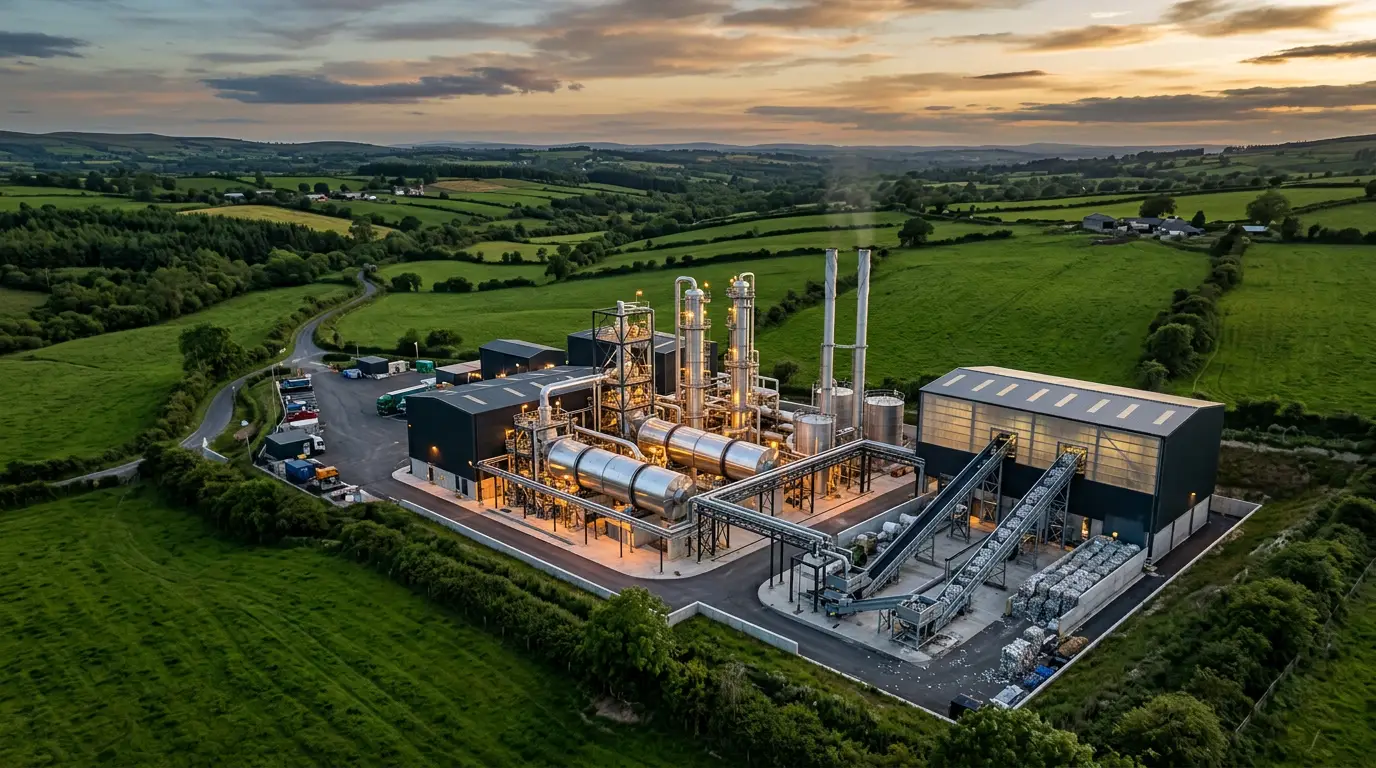
The numbers are stark. Despite Ireland's commendable progress on recycling targets, the country still generates in excess of 1.2 million tonnes of plastic waste annually, with a significant proportion destined for landfill, export, or incineration. As the European Union's Packaging and Packaging Waste Regulation (PPWR) beds in and mandatory recycled content targets begin to bite, the pressure on Irish industry to find credible, scalable end-of-life solutions for plastic has never been greater.
The answer, increasingly, lies not in the recycling bin but in the reactor vessel. Advanced pyrolysis — the thermochemical decomposition of plastic waste in the absence of oxygen — is emerging as the defining technology of the circular economy's next chapter. And for forward-thinking Irish businesses, the opportunity to lead this transition has never been more compelling.
What the EU's 2026 Regulatory Landscape Means for Irish Business
The PPWR, which entered into force earlier this year, introduces some of the most demanding plastic recycling obligations ever placed on European industry. By 2030, plastic contact-sensitive packaging must contain a minimum of 10% recycled content, with that figure rising to 50% by 2040. Critically, only material that meets strict EU definitions of mechanical or chemical recycling will count towards these thresholds.
For many plastic grades — particularly the mixed, contaminated, and multi-layer materials that make up a significant share of industrial and agricultural plastic waste — mechanical recycling simply cannot deliver the required purity or performance. The polymers degrade, the contaminants persist, and the resulting recyclate fails to meet food-contact or technical specifications. This is the gap that pyrolysis was built to fill.
Chemical recycling via pyrolysis breaks plastic waste down to its molecular building blocks — pyrolysis oil (also known as pyrolysis fuel oil, or PFO), syngas, and char. The pyrolysis oil can be fed back into petrochemical crackers as a feedstock, producing virgin-equivalent plastics that satisfy recycled content requirements. The circular loop, for the first time, closes properly.
For Irish manufacturers, retailers, and packaging producers facing audit pressure from both regulators and customers, partnering with a certified pyrolysis operator is rapidly becoming a strategic necessity, not merely an environmental aspiration.
Ireland's Specific Challenge — and Opportunity
Ireland occupies a curious position in the European waste hierarchy. On one hand, the country boasts strong recycling infrastructure and a genuinely committed environmental policy framework. On the other, its geographic position as an island economy creates acute challenges around waste export logistics, and its substantial agricultural sector generates vast quantities of contaminated plastic — silage wrap, bale netwrap, and polytunnel film — that conventional recycling streams simply cannot process at scale.
It is precisely these difficult materials that advanced pyrolysis handles most effectively. Unlike mechanical recycling, which demands clean, sorted, single-polymer streams, pyrolysis can process mixed plastic fractions including multi-layer packaging, agricultural plastics contaminated with soil, crop residue, and moisture, end-of-life tyres and rubber compounds, and waste that has previously been considered unrecyclable.
For Irish agribusiness, this represents a transformative shift. Farm plastic schemes have long struggled with the volumes and contamination levels they encounter. Pyrolysis provides a technically and commercially viable route to genuine circularity for agricultural plastics — converting farm waste into recovered oil that re-enters the supply chain as a valued resource.
The environmental calculus is equally compelling. Life cycle analyses consistently demonstrate that pyrolysis of plastic waste to fuel oil generates significantly lower greenhouse gas emissions than landfill or incineration, and in many cases approaches equivalence with primary fossil fuel production when system boundaries are correctly drawn. For businesses pursuing Science Based Targets (SBTi) or Scope 3 emissions reductions, this matters enormously.
How the Technology Works in Practice
Modern pyrolysis systems operate at temperatures typically ranging from 400°C to 700°C, with residence times and reactor configurations tuned to the feedstock and the desired output slate. At Premier Green Energy, our systems are engineered for continuous operation, high throughput, and maximum oil yield from mixed plastic feeds.
The process begins with feedstock preparation: incoming plastic waste is shredded, dried, and pre-sorted to remove metals and inorganic contaminants. The prepared material then enters the reactor vessel, where heat in the absence of oxygen causes the polymer chains to crack, producing a mixture of vapour-phase hydrocarbons. These vapours are cooled and condensed into pyrolysis oil, with non-condensable gases recovered for use as process fuel and char collected as a solid residue. Finally, the pyrolysis oil is characterised, blended where appropriate, and dispatched to offtake customers — typically petrochemical companies using the material as a cracker feedstock.
The entire process is designed for energy efficiency, with the non-condensable gas fraction providing much of the thermal energy required to sustain the reaction. In optimised systems, the net energy balance is strongly positive — a critical consideration as the cost of industrial energy remains elevated across Europe.
Building the Business Case: What to Expect From a Pyrolysis Partnership
For Irish businesses evaluating pyrolysis as part of their waste management strategy, the conversation typically begins with a waste characterisation study. Not all plastic streams are equally well-suited to pyrolysis — polypropylene, polyethylene, and polystyrene are excellent feedstocks; PVC and PET are more problematic and require careful management.
A credible pyrolysis operator will conduct a thorough feedstock assessment before any commercial agreement is finalised, covering plastic type and mixed fraction composition, contamination level and moisture content, available volumes and logistics for delivery, and certification and chain-of-custody requirements.
Waste generators — whether manufacturers, retailers, or agricultural enterprises — can typically expect to receive mass-balance certification under recognised schemes such as ISCC PLUS, which provides verifiable evidence that a given tonnage of plastic waste has been chemically recycled and its carbon content attributed to a specific volume of recycled feedstock. This certification is the currency of the recycled content market and is directly applicable to meeting PPWR obligations.
The commercial model varies, but in most cases businesses pay a gate fee for plastic waste processing — generally significantly lower than the cost of landfill or export once haulage is factored in — and receive certified recycled content credits in return. For businesses with ambitious sustainability targets or customer-facing recycled content commitments, the value of those credits extends well beyond the gate fee.
The Road Ahead
The trajectory for pyrolysis in Ireland and across Europe is unambiguously positive. Regulatory drivers are intensifying, investment is flowing into new capacity, and the major petrochemical companies — who represent the primary offtake market for pyrolysis oil — have made clear, long-term commitments to chemical recycling feedstocks as part of their own decarbonisation strategies.
What remains is the work of matching Ireland's substantial plastic waste resource with the processing capacity and commercial frameworks needed to realise its value. That is precisely the work Premier Green Energy is engaged in, and the opportunity for Irish businesses to position themselves at the forefront of this transition is very much still open.
Ready to Close the Loop on Your Plastic Waste?
Whether you are a manufacturer facing PPWR compliance deadlines, an agricultural enterprise seeking a credible end-of-life route for farm plastics, or a sustainability professional building out your Scope 3 reporting, Premier Green Energy can help you navigate the commercial and technical landscape of chemical recycling. Contact our team today to arrange a feedstock assessment and discover how pyrolysis can transform your plastic waste liability into a circular economy asset.


.svg)
.svg)