What Is Pyrolysis? A Plain-English Guide for Irish Businesses and Waste Managers

Pyrolysis: The Word That's Changing Irish Waste Management
If you work in waste management, energy, or sustainability in Ireland, you may have come across the word "pyrolysis" with increasing frequency over the past few years. It is a term that sits at the intersection of waste treatment and renewable energy — and it is central to the technology developed and deployed by Premier Green Energy.
But what does pyrolysis actually mean, and why does it matter? This guide explains the process in plain language, with a focus on what it means for Irish businesses, waste operators, and local authorities considering their options for residual waste treatment.
The Basic Science: What Pyrolysis Is
Pyrolysis is a thermal decomposition process. It uses high temperatures — typically between 400°C and 900°C depending on the system and feedstock — to break down organic or carbon-containing materials. The critical distinction from incineration is that pyrolysis takes place in a low-oxygen or oxygen-free environment. The material does not burn; it decomposes.
When organic waste is subjected to pyrolysis, the complex molecular structures that make up the material are broken apart by heat. This produces three distinct outputs:
- Syngas (synthetic gas) — a combustible gas mixture, primarily hydrogen and carbon monoxide, which is the main energy-bearing output
- Carbon char (biochar) — the solid residue remaining after volatile components are driven off; a stable, carbon-rich material
- Liquids — oils and water produced during the process, which are managed and can be recovered or further processed depending on the system design
The relative proportion of each output depends on the temperature, residence time, and feedstock composition — parameters that can be optimised for different objectives.
How Premier Green Energy Uses Pyrolysis: The PRIMA 3000
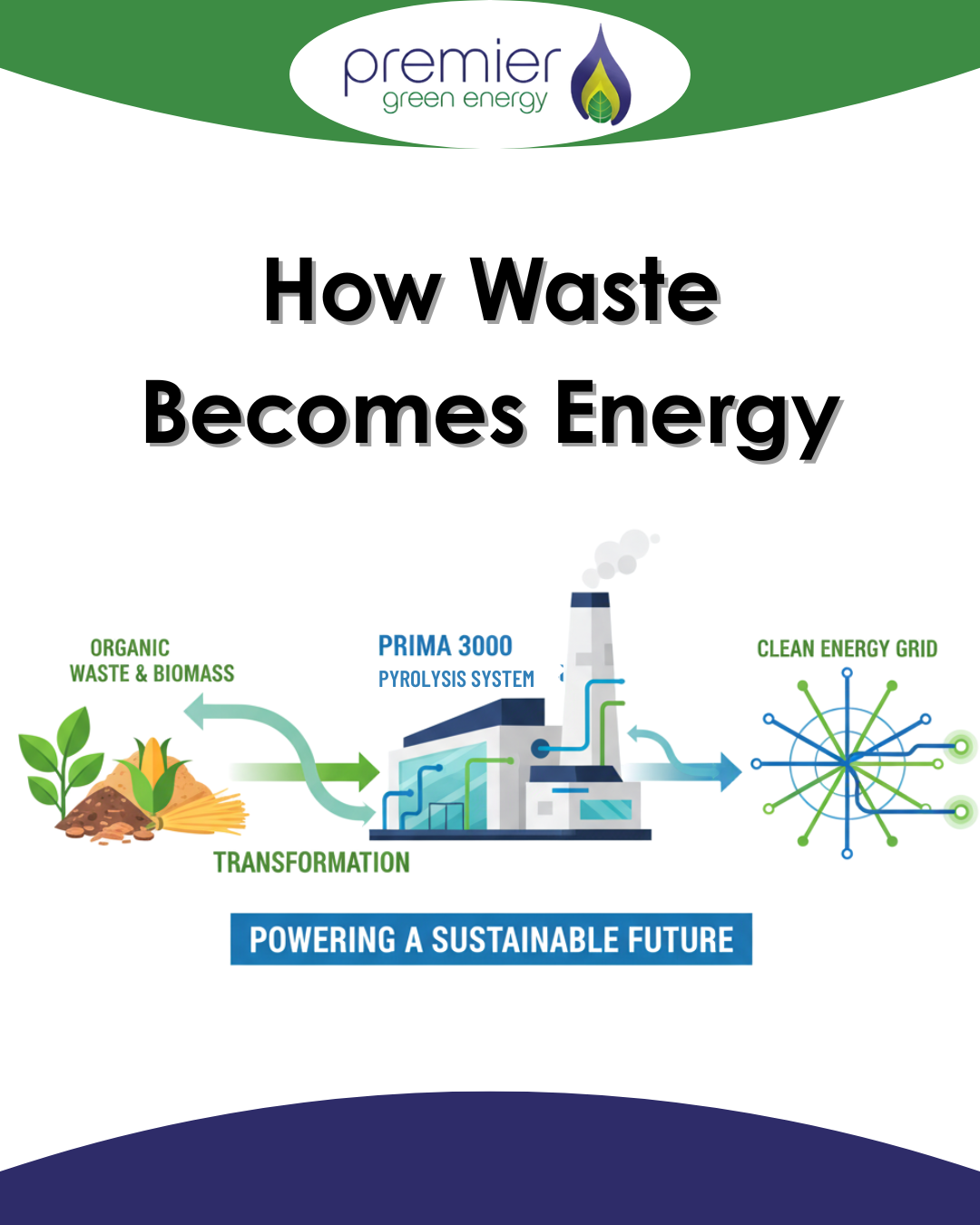
Premier Green Energy's patented PRIMA 3000 system is an advanced pyrolysis unit designed specifically for commercial-scale waste-to-energy applications. It processes refuse-derived fuel (RDF) — a standardised fuel produced from non-recyclable waste — and is engineered to maximise the quality and energy yield of the syngas produced.
The PRIMA 3000 operates in a tightly controlled environment. Temperature, pressure, and gas composition are monitored and managed to ensure consistent syngas quality. This clean syngas is then used to power gas engines, generating up to 3 Megawatts of electrical power from each unit processing approximately 3 tonnes of RDF.
The solid carbon char output is collected and can be used as a soil amendment (biochar), for carbon sequestration, or in industrial applications. Heat generated during the process can be recovered and used on-site or supplied to adjacent facilities. Water driven off from the feedstock is captured and managed as part of the plant's environmental management system.
Where Premier Green Energy's Pyrolysis Plants Operate
Premier Green Energy has demonstrated the PRIMA 3000 at commercial scale at two sites:
- Hirwaun, Wales — Premier Green Energy's flagship operational plant, continuously generating electricity from RDF using the PRIMA 3000 system
- Thurles, Co. Tipperary, Ireland — an operational Irish plant demonstrating the technology in an Irish regulatory and waste management context
These are not pilot projects or prototypes. They are commercial-scale operational facilities, providing real-world evidence of the PRIMA 3000's performance, reliability, and outputs.
How Pyrolysis Differs from Incineration
The most common question asked by Irish waste managers and sustainability professionals is: how is pyrolysis different from incineration?
The answer lies in the process environment and the outputs. Incineration involves direct combustion — waste is burned in the presence of oxygen, producing heat (used to generate steam and electricity), flue gases, and ash. The waste is largely destroyed in the process.
Pyrolysis, by contrast, thermally decomposes waste without direct combustion. The primary outputs are a combustible gas (syngas) rather than hot combustion gases, a stable solid (carbon char) rather than inert ash, and a more controllable, lower-temperature emissions profile at the point of treatment.
The PRIMA 3000 is also modular and scalable at a smaller footprint than conventional large-scale incineration facilities, making it more suitable for distributed deployment across multiple locations in Ireland.
Why Pyrolysis Matters for Ireland
Ireland faces a significant challenge: substantial volumes of residual waste that cannot be recycled, a limited domestic energy-from-waste infrastructure, rising landfill costs, and tightening diversion targets. Pyrolysis — and specifically the PRIMA 3000 — addresses this challenge with a proven, commercially operational technology.
For Irish waste management companies, it offers a domestic treatment route that generates value rather than simply incurring disposal costs. For industrial operators, it offers a route to improved sustainability performance for residual waste streams. For local authorities, it offers an alternative to landfill and expensive export. And for Ireland's energy system, it adds a source of renewable electricity generated from material that would otherwise be a liability.
Key Takeaways
- Pyrolysis is a thermal decomposition process that breaks down waste at high temperatures in a low-oxygen environment — it is not incineration
- The primary outputs are syngas (used to generate electricity), carbon char (used as biochar or for carbon sequestration), and recovered heat and water
- Premier Green Energy's PRIMA 3000 processes RDF to generate up to 3 MW of electrical power per unit
- Operational plants in Hirwaun, Wales and Thurles, Co. Tipperary provide commercial-scale evidence of the technology's performance
- Pyrolysis offers a viable, value-generating alternative to landfill and export for Irish residual waste operators


.svg)
.svg)