PRIMA 3000: Understanding the Energy Outputs of Pyrolysis — Syngas, Carbon Char & Recovered Heat

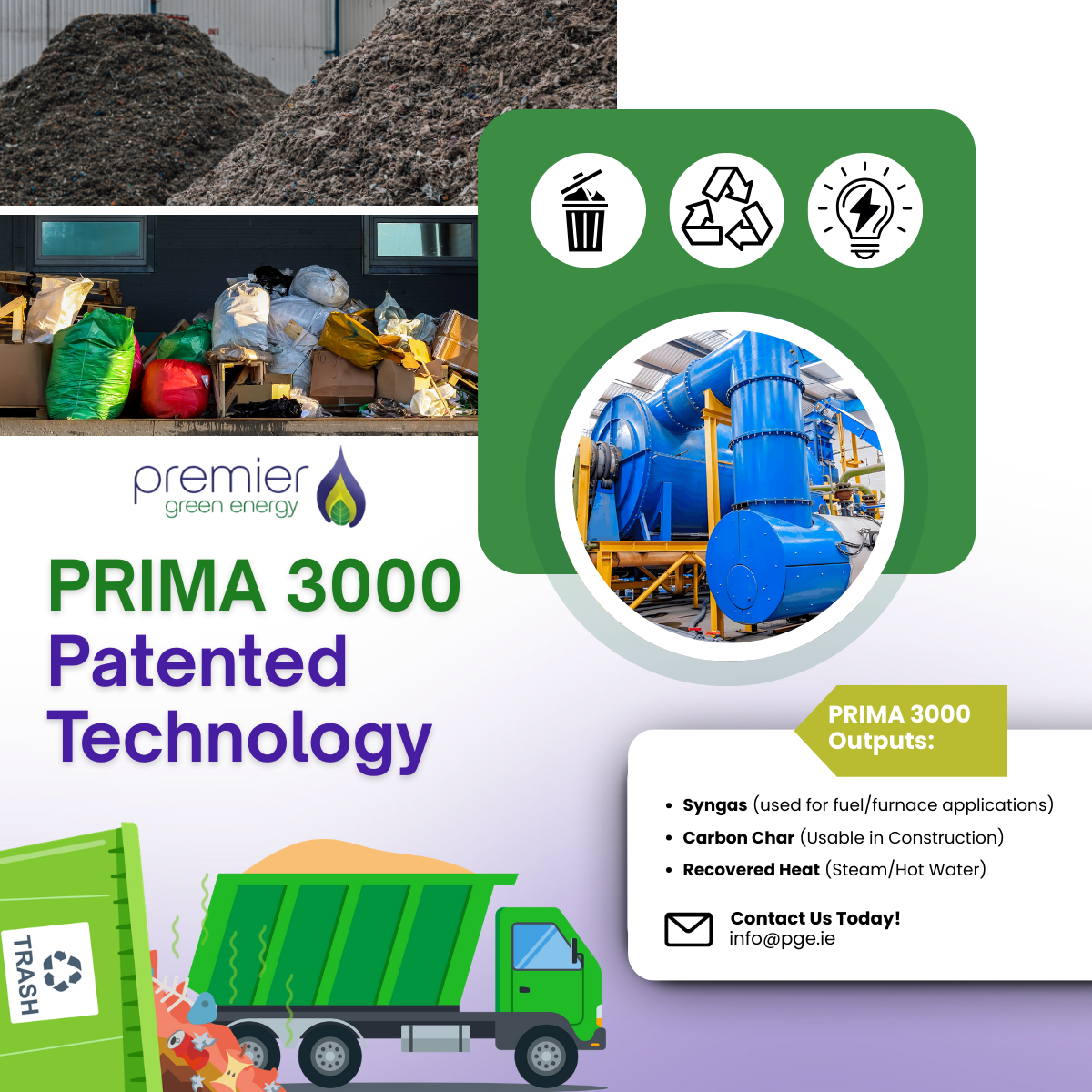
More Than Megawatts: The Full Value of the PRIMA 3000
When people think about waste-to-energy technology, they typically think about electricity. And while the PRIMA 3000 — Premier Green Energy's patented pyrolysis system — is capable of generating up to 3 Megawatts of electrical power from just 3 tonnes of refuse-derived fuel (RDF), the story doesn't end there.
The PRIMA 3000 is a multi-output system. Through the pyrolysis process, it produces three distinct and valuable outputs: high-quality syngas (synthetic gas), carbon char (biochar), and recovered heat and water. Understanding each of these outputs reveals just how comprehensively the PRIMA 3000 extracts value from waste — and why it represents a genuinely circular approach to energy recovery.
Output 1: High-Quality Syngas (Synthetic Gas)
The primary energy output of the PRIMA 3000 is syngas — a combustible mixture of gases, principally hydrogen (H₂) and carbon monoxide (CO), produced when waste materials are thermally broken down in a low-oxygen environment at high temperatures.
Unlike combustion, which burns waste directly, pyrolysis converts the carbon-rich content of the feedstock into this synthetic gas without full oxidation. The result is a clean, energy-dense gas that can be used for:
- Electricity generation — syngas is fed into gas engines or turbines to produce power, enabling the PRIMA 3000's headline output of up to 3 MW of electrical energy
- Industrial heat supply — surplus syngas can be used to supply thermal energy to nearby industrial processes
- Grid export or on-site use — generated power can be exported to the national grid or consumed on-site, reducing energy costs for operators
The quality of the syngas produced by the PRIMA 3000 is a key differentiator. Operating within tightly controlled temperature and pressure parameters, the system minimises tar and particulate content in the gas stream, producing a cleaner syngas that performs more reliably in downstream energy generation equipment.
At Premier Green Energy's flagship plant in Hirwaun, Wales, syngas produced by the PRIMA 3000 is used to generate electricity continuously, demonstrating the technology's real-world capability at commercial scale.
Output 2: Carbon Char (Biochar)
The second major output of the pyrolysis process is carbon char — often referred to as biochar when derived from organic or biomass-based feedstocks. This is the solid residue that remains after the volatile gases have been driven off from the waste material during thermal treatment.
Carbon char from the PRIMA 3000 is a highly stable, carbon-rich material with a range of potential applications depending on its composition and quality:
- Soil amendment — biochar is well established as a soil conditioner. Its porous structure improves water retention and aeration, supports microbial activity, and can improve nutrient uptake in agricultural soils
- Carbon sequestration — biochar is highly resistant to decomposition, meaning the carbon captured within it remains locked out of the atmosphere for centuries. This makes it a genuine carbon removal tool, not just a carbon avoidance measure
- Industrial applications — depending on purity, carbon char can be processed for use in industrial filtration, as a substitute for coal in certain manufacturing processes, or as a raw material for further chemical processing
The significance of carbon char in the context of net-zero strategy should not be understated. Conventional waste disposal — particularly landfill — results in carbon re-entering the atmosphere through decomposition or methane emissions. The PRIMA 3000 instead locks that carbon into a stable solid form, contributing directly to carbon removal targets.
At Premier Green Energy's plant in Thurles, Co. Tipperary, the management of solid outputs including carbon char is integrated into the plant's overall operational model, ensuring nothing from the process is wasted.
Output 3: Recovered Heat and Water
The third category of outputs from the PRIMA 3000 is perhaps the least discussed but equally important in a full systems efficiency analysis: recovered heat and water.
High-temperature pyrolysis generates significant thermal energy as a byproduct of the gas and char production process. In a well-designed system, this heat is not allowed to dissipate — it is captured and put to productive use:
- Process heat recovery — recovered heat can be fed back into the pyrolysis system itself to maintain operating temperatures, reducing the external energy input required and improving overall plant efficiency
- District heating or industrial supply — where site conditions allow, surplus heat can be exported to adjacent buildings, industrial facilities, or district heating networks, maximising the total energy value extracted from each tonne of waste
- Drying pre-treatment — recovered heat is particularly valuable for drying feedstock material prior to processing, which is especially relevant when working with refuse-derived fuel (RDF) that may carry moisture
Water recovery is also a feature of the PRIMA 3000 process. Moisture driven off from the feedstock during thermal treatment can be captured, treated, and reused within the plant's water management systems, reducing the facility's overall water consumption and minimising liquid waste discharge.
Together, heat and water recovery reflect a broader design philosophy behind the PRIMA 3000: that every unit of energy and every material output should be accounted for and used where possible.

A System Built Around Full Resource Recovery
What sets the PRIMA 3000 apart is not any single output in isolation, but the way the system is designed to maximise the value extracted from every tonne of waste processed. Syngas drives electrical generation. Carbon char creates long-term carbon value and potential soil benefits. Recovered heat and water reduce operating costs and environmental footprint.
This multi-output approach reflects the principles of the circular economy — keeping materials in productive use for as long as possible, and extracting maximum value before anything enters final disposal.
With installations operating in Hirwaun, Wales and Thurles, Co. Tipperary, Premier Green Energy continues to demonstrate that this is not a theoretical proposition. The PRIMA 3000 is operational, proven, and delivering measurable results across all three output streams.
Key Takeaways
- The PRIMA 3000 produces three distinct outputs: syngas, carbon char, and recovered heat/water
- Syngas is used to generate up to 3 MW of electrical power from 3 tonnes of RDF
- Carbon char (biochar) offers soil improvement, carbon sequestration, and industrial applications
- Recovered heat improves plant efficiency and can supply adjacent facilities
- Water recovery reduces consumption and minimises liquid waste
- The system reflects a whole-resource approach to waste-to-energy conversion


.svg)
.svg)